My Journey into Educational Neuroscience
Bringing education and neuroscience together may seem odd at first, but what makes the mother of a child with learning and reading challenges want to learn more about it?
ARTICLES

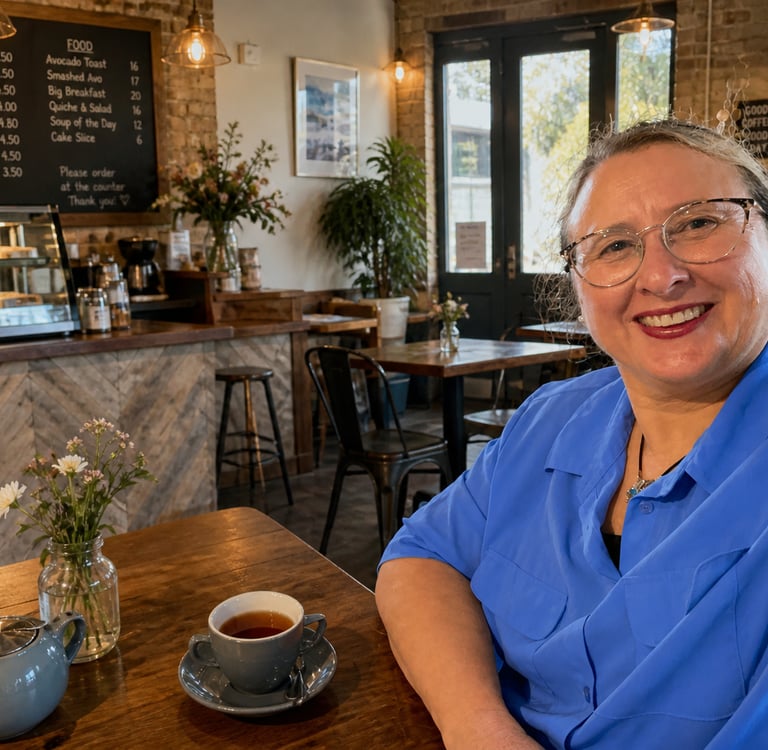
If someone had told me thirty years that I would be helping children and adults with learning and reading challenges, I wouldn't have believed them. After all, I was selling French bread at the time and very busy visiting the best hotels and restaurants in Sydney with my picnic basket of samples. Life trajectories have a habit of changing however, and before I knew it, I had a little boy who was having a terrible time at school.
I wasn’t searching for neuroscience.
I was searching for answers.
Like many parents, I simply wanted to understand why learning seemed so much harder for my son than it did for other children. He was bright, funny and curious, yet reading, listening and learning were often exhausting. We tried speech therapy, tutoring and many of the traditional supports available, and while each helped in its own way, I always felt there was something deeper that nobody had quite explained.
Then one day I came across Dr Norman Doidge’s remarkable book The Brain That Changes Itself.
Buried within its pages was a chapter describing a program called Fast ForWord. It wasn’t presented as another learn to read program or another set of reading worksheets. Instead, it described something completely different: using the brain’s ability to change itself—its neuroplasticity—to improve the underlying skills needed for language and learning.
It stopped me in my tracks.
For the first time, I wasn’t just asking, “How do we teach reading better?”
I was asking, “How does the brain learn to read in the first place?”
That question changed the direction of my life.
The more I learned about neuroplasticity, the more I realised that learning isn’t simply about intelligence or effort. Behind every child who struggles to read may be a brain that is still developing important foundations such as auditory processing, attention, working memory, processing speed, sequencing or language skills.
When those foundations become stronger, learning itself can become easier.
That idea gave me enormous hope.
It also gave me a mission.
Over the following years I immersed myself in learning everything I could. I had the privilege of working alongside a speech pathologist delivering Fast ForWord to children and adults, watching people make gains that often extended well beyond reading. I became fascinated by how the brain adapts through repetition, challenge and the right kind of practice by studying the work of Dr Michael Merzenich (who had worked on the cochlear implant with Professor Graeme Clark) and his team of neuroscientists.
Some years ago, I completed Dr Daniel Amen’s Brain Health Trainer program, which broadened my understanding that learning doesn’t happen in isolation. Sleep, exercise, nutrition, stress and emotional wellbeing all influence how our brains perform every day.
And just recently, I completed a short course in Educational Neuroscience through FutureLearn in partnership with CQUniversity Australia.
For me, this is another important milestone.
Educational neuroscience sits at the intersection of brain science, cognitive psychology and education. Rather than seeing these as separate fields, it asks how our growing understanding of the brain can help teachers, tutors and parents make better decisions about learning and reading instruction.
I find that incredibly exciting.
For many years there has been debate about whether neuroscience belongs in education. While it certainly isn’t a magic solution, I believe we’re reaching a point where the partnership is becoming increasingly valuable.
We now know far more about attention, memory, emotion, language development and neuroplasticity than we did even a generation ago.
Surely that’s knowledge worth sharing with the people who teach our children every day.
One of the biggest lessons I’ve learned is that neuroscience doesn’t replace good teaching.
It strengthens it.
Children still need explicit instruction. They still need practice, encouragement and caring adults who believe in them. The Science of Reading has shown us much about how reading should be taught, and neuroscience helps explain why many of those approaches work so well.
For children who find learning especially difficult, understanding how the brain develops can also open doors to additional supports that target the skills underneath learning itself.
That perspective has shaped the way I work through Learnerobics.
I’m not interested in chasing educational fads or promising miracle cures. Instead, I want to bridge the gap between neuroscience and learning and reading challenges. My goal is to take complex research and translate it into practical, hopeful ideas that parents, tutors and teachers can actually use.
Because behind every research paper is a real child.
A child who wants to keep up with their classmates.
A parent lying awake at two o’clock in the morning wondering what else they can do.
A teacher and/or tutor trying their absolute best with the knowledge and resources they have.
If neuroscience can help even a little, then it’s worth exploring.
I’m still learning.
In fact, I hope I never stop learning.
Educational neuroscience is evolving rapidly, and every new study brings fresh insights into how our incredible brains grow, adapt and learn. I look forward to continuing that journey and sharing what I discover along the way.
Because when learning or reading is hard, working with the brain simply makes sense.
Learnerobics
Mission: Develop attention, memory, language and mindset skills in children and adults with learning and reading challenges.
Vision: We see a future where learning and reading challenges no longer limit confidence and living a life of purpose.
©Learnerobics, 2026
139 Menangle Street, Picton, NSW 2571 Australia
monique@learnerobics.com.au
The information on this website is provided for educational and informational purposes only and is not a substitute for professional medical, educational, psychological, or healthcare advice. Always consult a qualified health care professional regarding your individual circumstances. Results may vary between indiviuals.